 Plant Decoded
Why do roots always grow down?
No eyes, no inner ear, no brain. A root still knows which way is down.
 By
Short answer
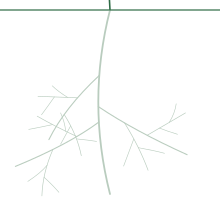
Roots grow down because cells in the root tip hold heavy starch grains that sink towards whichever side is down. Where they settle tells the root which way gravity points. The root then sends growth hormone to its lower side, which slows growth there, so the tip curves down.
Where the root’s gravity sensor sits
Plant a seed upside down and it doesn’t care. The root still finds its way down and the shoot still finds its way up. This is called gravitropism, and it all starts at the very tip of the root.
In a small cap of cells called the columella, there are starch-packed grains called statoliths. They’re denser than everything around them, so they sink, the way sand settles to the bottom of a glass of water. Turn the root on its side and within minutes the grains slide over and settle against the new floor of each cell.
Why more hormone means less growth
That settling is the signal. The cell reads where its grains have landed and starts sending auxin, a growth hormone, towards the lower side of the root.
Here’s the counterintuitive bit. In roots, a lot of auxin slows cell growth down. So the upper side keeps stretching while the lower side holds back, and the tip curves downward. Once it’s pointing straight down again, the grains settle evenly, auxin evens out, and the root carries on straight.
What about shoots?
Shoots use the same idea with the opposite result. In stems, extra auxin on the lower side speeds growth up, so the lower side stretches more and the stem curves upward. Same sensor, same hormone, opposite response. It’s an elegant bit of design.
What happens to roots in space?
Without gravity, roots lose their main compass. Plants grown on space stations still grow, but their roots wander at odd angles, steered more by light and water. It’s one of the reasons growing food in space is harder than it sounds.
 For the curious
Below the surface: how a sinking grain becomes a message
The statoliths are amyloplasts, small compartments packed with starch. The idea that sinking starch senses gravity was proposed independently by Gottlieb Haberlandt and Bohumil Němec in 1900, and it has held up: plants that can’t make starch still bend towards gravity, just far more slowly.
The bend itself depends on auxin carriers called PIN proteins. In the columella, PIN3 and PIN7 shift towards the new lower face of the cell after the root tilts, steering auxin downward. Other carriers then move it back through the outer cell layers to the zone just behind the tip, where the bend happens.
The missing piece for a century was the handover. How does a grain resting on one side of a cell tell the membrane where it is? The answer came from proteins called LZY. They sit on the amyloplasts, and when the grains settle, LZY moves onto the cell membrane right beside them, marking which side is down. In 2023, researchers pushed the grains sideways with a focused laser inside living root cells, and LZY followed them, even against gravity.
How sure are we?
Quick questions
What is gravitropism?
It’s a plant’s growth response to gravity. Roots grow towards it and shoots grow away from it.
Do roots grow towards water?
Yes, through a separate response called hydrotropism. In soil, gravity and water work together to steer roots.
Why do some roots grow above the soil?
Some plants do it on purpose, like the breathing roots of mangroves. In a houseplant, roots creeping over the top usually mean the pot is too small.
Sources
- Nishimura T, Mori S, Shikata H, et al. (2023). Cell polarity linked to gravity sensing is generated by LZY translocation from statoliths to the plasma membrane. Science 381: 1006–1010. Read the paper
Spotted something that looks wrong? Email hello@plantdecoded.com and it’ll be checked and corrected.